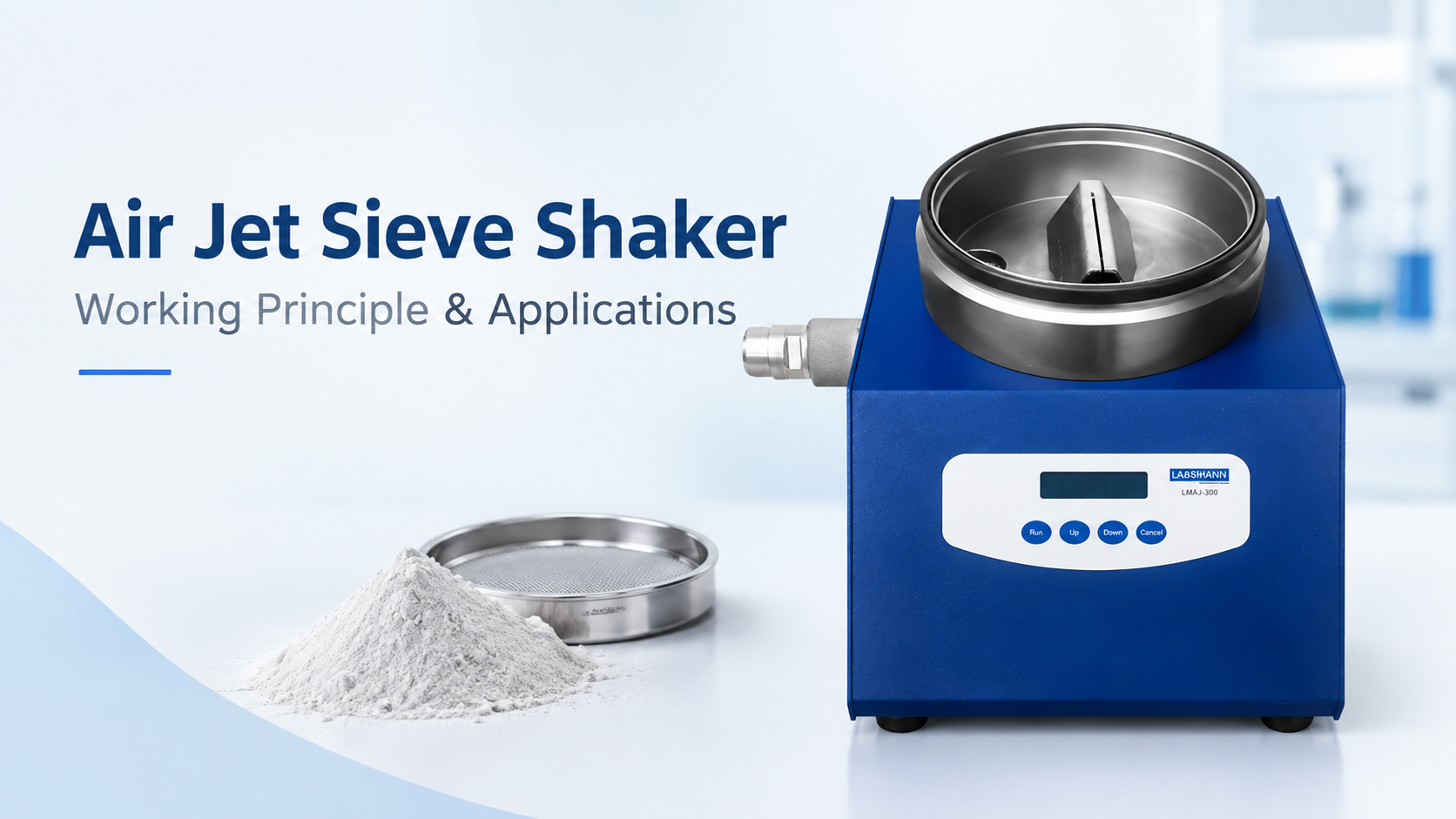
Particle size analysis is an essential quality-control process in laboratories and industries that handle powders, granules, and fine materials. Accurate particle-size measurement helps manufacturers maintain product consistency, improve processing efficiency, and meet required quality standards. An Air Jet Sieve Shaker is a specialized laboratory instrument designed for the efficient separation and analysis of fine powder particles using controlled airflow.
For laboratories working with fine and dry powders, an AirJet Sieve Shaker for laboratories provides an efficient method for determining particle-size distribution. Ark Scientific offers laboratory equipment and testing solutions designed to support reliable material characterization and quality-control applications.
What Is an Air Jet Sieve Shaker?
An Air Jet Sieve Shaker is a particle-size analysis instrument used primarily for testing fine and dry powders. Unlike conventional sieve shakers that use mechanical vibration or oscillation, an air jet sieve uses a controlled stream of air to disperse particles and assist their movement through a test sieve.
This technique is particularly useful for materials that are very fine, lightweight, or prone to agglomeration. The airflow helps separate particles effectively while reducing the possibility of sieve blockage caused by fine powder.
The instrument typically works with standardized test sieves and a vacuum system. Depending on the material and required analysis, different sieve mesh sizes can be selected to determine the particle-size distribution of a sample.
Air Jet Sieve Shaker Working Principle
The working principle of an Air Jet Sieve Shaker is based on controlled airflow, particle dispersion, and sieving.
First, a measured quantity of dry powder is placed evenly on the surface of the selected test sieve. The sieve is then securely mounted on the instrument. A vacuum system draws air through the sieve while an air jet disperses the powder across the sieve surface.
The airflow lifts and separates the fine particles. Particles that are smaller than the openings in the sieve pass through the mesh along with the air and are collected in the receiving or vacuum system. Particles that are larger than the sieve openings remain on the sieve.
During the process, the air jet helps prevent excessive accumulation of powder on the mesh. This makes the method especially suitable for fine powders that may be difficult to separate using conventional mechanical sieving.
After the specified sieving time, the material retained on the sieve is weighed. The weight can then be used to calculate the percentage of material retained and determine the particle-size characteristics of the sample.
Advantages of Air Jet Sieve Shaker
An Air Jet Sieve Shaker offers several benefits for laboratory particle-size testing:
- Effective fine-powder separation: Controlled airflow improves the separation of very fine particles.
- Reduced sieve clogging: Air movement helps keep fine particles from blocking sieve openings.
- Better particle dispersion: The air jet helps break up loose agglomerates during analysis.
- Reliable testing: Controlled operating conditions can support repeatable particle-size measurements.
- Suitable for dry powders: The method is particularly useful for dry, fine, and lightweight materials.
- Efficient laboratory operation: Air jet sieving can be incorporated into routine quality-control procedures.
Applications of Air Jet Sieve Shaker
Air Jet Sieve Shakers are used across several industries where accurate particle-size analysis is important.
Pharmaceutical Industry
Particle size can affect powder flow, mixing, dissolution, and formulation performance. Air jet sieving can be used to evaluate pharmaceutical powders, excipients, and other dry materials during quality-control and research activities.
Chemical Industry
Chemical powders and fine raw materials often require consistent particle-size characteristics. Air jet sieve analysis helps laboratories evaluate materials and monitor particle-size distribution during production and quality testing.
Food and Beverage Industry
Fine food ingredients such as flour, starch, powdered sugar, spices, and other dry powders can be tested using air jet sieving. Particle-size analysis helps manufacturers maintain consistency in raw materials and finished products.
Mineral and Material Processing
Mineral powders, pigments, fillers, and other finely processed materials can be analyzed using an Air Jet Sieve Shaker. Particle-size information is useful for evaluating material quality and processing performance.
Cement and Construction Materials
Fine cement, mineral additives, and other powdered construction materials can require controlled particle-size characteristics. Air jet sieve testing can assist laboratories in evaluating powder fineness and consistency.
Research and Development
R&D laboratories use air jet sieving to study new materials, compare different powder samples, evaluate raw materials, and develop improved formulations and processing methods.
Why Choose an Air Jet Sieve Shaker for Laboratories?
An AirJet Sieve Shaker for laboratories is particularly valuable when conventional mechanical sieving does not provide sufficient separation of fine powder particles. The combination of controlled airflow and standardized sieves allows laboratories to perform efficient particle-size testing while minimizing issues such as particle agglomeration and mesh blockage.
It can be integrated into routine quality-control workflows and used for raw-material inspection, product development, process monitoring, and comparative material analysis.
Conclusion
An Air Jet Sieve Shaker is an effective laboratory solution for particle-size analysis of fine and dry powders. Its controlled airflow helps disperse particles, reduce sieve blockage, and improve the separation of fine materials.
From pharmaceuticals and chemicals to food, minerals, cement, and research laboratories, accurate particle-size analysis plays an important role in maintaining material quality and process consistency.
For laboratories looking for dependable solutions for fine-powder testing and material characterization, Ark Scientific offers laboratory equipment designed to support efficient and accurate testing requirements.