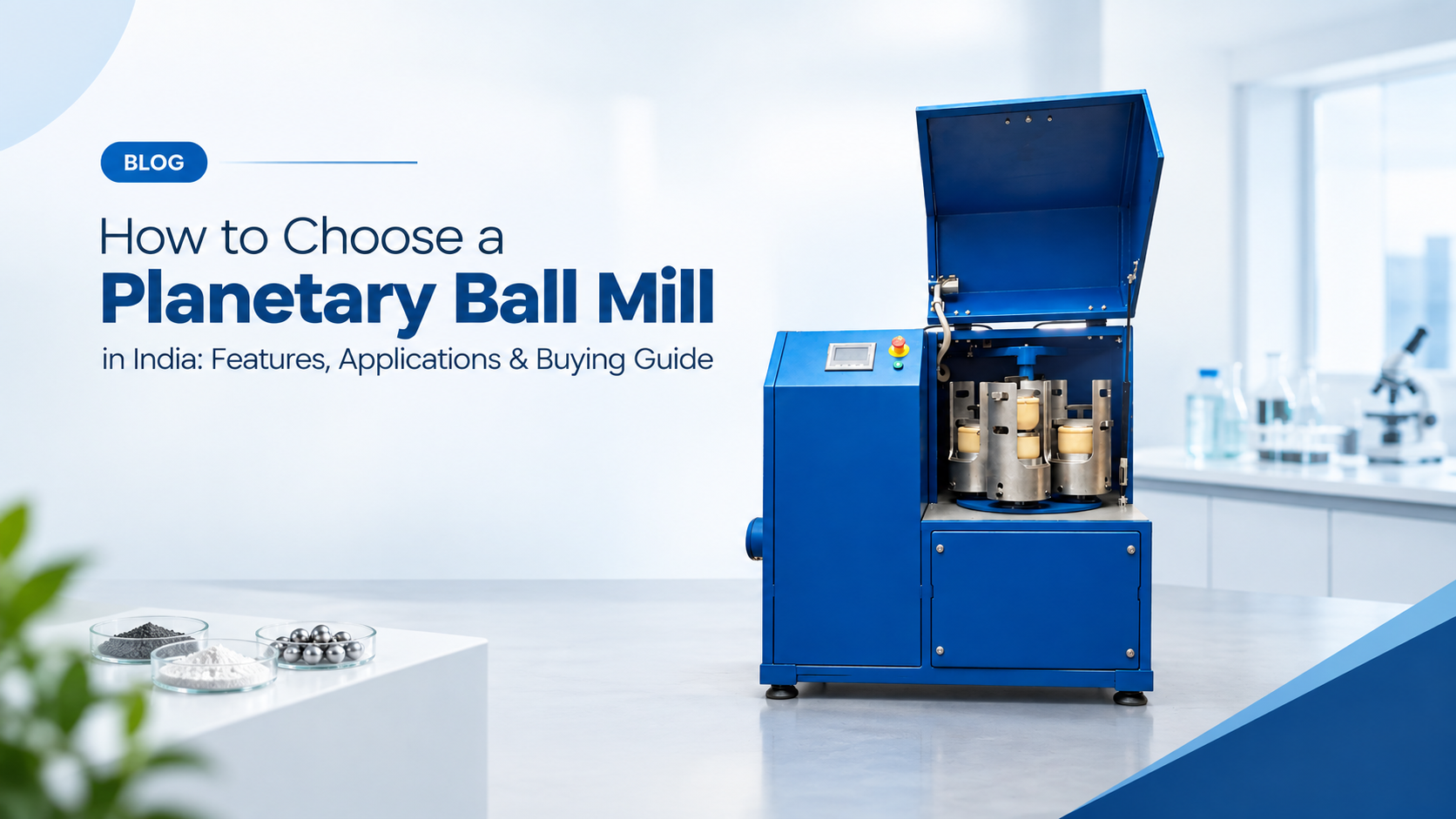
Choosing the right planetary ball mill is important for laboratories, research institutions, universities, pharmaceutical companies, material testing laboratories, and industrial R&D facilities involved in fine grinding and sample preparation. Different materials require different grinding conditions, jar capacities, speeds, and grinding media.
A planetary ball mill is designed for high-energy grinding, mixing, homogenization, and mechanical alloying of various materials. Before selecting a machine, it is important to understand the material being processed, required particle size, sample quantity, grinding method, and application requirements.
This guide explains the important features, applications, and factors to consider when choosing a planetary ball mill in India.
What Is a Planetary Ball Mill?
A planetary ball mill is a laboratory grinding machine that uses high-energy impact and friction to reduce materials to very fine particle sizes. The grinding jars rotate around their own axes while also rotating around the central axis of the machine.
This combined movement produces high-energy grinding action, making planetary ball mills suitable for applications where fine and controlled particle-size reduction is required.
Planetary ball mills are commonly used for:
- Fine grinding
- Sample preparation
- Mixing and homogenization
- Mechanical alloying
- Material research
- Nanomaterial preparation
- Pharmaceutical research
- Chemical research
- Ceramic and geological sample preparation
How Does a Planetary Ball Mill Work?
A planetary ball mill uses grinding jars containing the sample material and grinding balls. During operation, the jars rotate at high speed around a central axis while the jars themselves rotate in the opposite direction.
This movement creates centrifugal forces and high-energy impacts between the grinding balls and the material.
The grinding process generally depends on several factors, including:
- Rotation speed
- Grinding time
- Grinding jar size
- Grinding ball size
- Grinding media material
- Material properties
- Ball-to-material ratio
- Dry or wet grinding conditions
Selecting the correct combination of these parameters can significantly influence the final particle size and grinding efficiency.
Key Features to Consider When Choosing a Planetary Ball Mill
1. Grinding Capacity
Grinding capacity is one of the first specifications to evaluate. Select a machine according to the amount of material that needs to be processed during each batch.
For laboratory research, smaller grinding jars may be sufficient, while R&D applications requiring larger sample quantities may need higher-capacity jars.
2. Final Particle Size
Consider the particle size required for your application.
If your research requires very fine powder, choose a planetary ball mill capable of achieving the required final fineness under suitable grinding conditions.
Always check the manufacturer's stated performance specifications rather than selecting equipment based only on maximum speed.
3. Grinding Jar Capacity
Grinding jars are available in different capacities and materials.
The appropriate jar size depends on:
- Sample quantity
- Material characteristics
- Required grinding conditions
- Grinding method
- Number of samples processed
Using the correct jar capacity helps achieve consistent grinding results.
4. Grinding Media
Grinding balls are available in different sizes and materials. Common grinding media materials include stainless steel, zirconia, tungsten carbide, and other specialized materials.
The grinding media should be selected according to:
- Sample hardness
- Required final particle size
- Chemical compatibility
- Contamination requirements
- Grinding application
5. Speed and Energy
The rotational speed of a planetary ball mill influences the energy transferred to the sample.
Higher speed does not always mean better results. The correct operating speed depends on the material, grinding media, jar size, and desired particle size.
A machine with programmable operating parameters can provide greater control over laboratory grinding processes.
6. Dry and Wet Grinding Capability
Some applications require dry grinding, while others benefit from wet grinding.
Before selecting a planetary ball mill, determine whether your application requires dry or wet grinding.
Applications of Planetary Ball Mills
Planetary ball mills are used in a wide range of scientific and industrial research applications.
Material Science
Researchers use planetary ball mills for fine grinding, mixing, material modification, and mechanical alloying.
Nanotechnology
High-energy grinding can be used as part of research involving fine powders and nanomaterials.
Pharmaceutical Research
Planetary ball mills can be used for sample preparation, particle-size reduction, mixing, and formulation-related research.
Chemical Research
Laboratories use planetary ball mills for grinding and homogenizing chemical samples and materials.
Ceramics
Planetary ball mills are used to process ceramic powders and prepare materials for further laboratory research.
Geology and Mining
Rock, mineral, and ore samples can be prepared for laboratory analysis using suitable grinding equipment.
Battery and Energy Materials
Researchers working with battery materials and advanced energy-storage materials may use planetary ball mills for mixing, grinding, and mechanical processing.
How to Choose the Right Planetary Ball Mill in India
When comparing planetary ball mills, consider the following factors:
What material will you process?
Hard, brittle, soft, fibrous, abrasive, and chemically sensitive materials may require different grinding conditions.
What particle size do you need?
Define the required final particle size before selecting the equipment.
How much material will you process?
Choose the grinding jar capacity according to your normal laboratory batch size.
Do you need dry or wet grinding?
Determine which grinding method is appropriate for your application.
What grinding media should you use?
Select grinding balls according to hardness, chemical compatibility, contamination requirements, and desired grinding results.
Do you need programmable controls?
For repeatable research experiments, programmable speed, time, and operating cycles can help maintain consistent grinding conditions.
Planetary Ball Mill at Best Price in India: What Should You Consider?
When searching online for a Planetary Ball Mill at Best Price in India, buyers should not compare machines based only on the advertised price.
The overall value of a planetary ball mill depends on its technical specifications, grinding capacity, construction, control system, grinding jar options, accessories, and suitability for the intended application.
Before making a purchase, compare:
- Grinding capacity
- Number of grinding stations
- Maximum rotational speed
- Grinding jar capacity
- Grinding media compatibility
- Final achievable particle size
- Dry and wet grinding capability
- Programmable controls
- Safety features
- Accessories
- Technical support
- Spare-parts availability
A machine that matches the laboratory's requirements can provide better long-term value than simply selecting the lowest-priced option.
Why Choose ARK Scientific for a Planetary Ball Mill?
ARK Scientific provides laboratory sample-preparation and material-processing equipment for research and industrial applications.
The LM-PBM4000 Planetary Ball Mill is designed for laboratory grinding and material-processing applications where fine particle-size reduction and controlled grinding are required.
The machine supports applications involving dry and wet grinding and can be configured with different grinding jars and grinding media according to application requirements.
For detailed specifications, operating parameters, jar options, and available configurations, refer to the LM-PBM4000 Planetary Ball Mill product page.
Factors Affecting Planetary Ball Mill Price in India
The price of a planetary ball mill can vary depending on its specifications and configuration.
Important factors include:
- Machine capacity
- Number of grinding stations
- Motor and drive system
- Maximum speed
- Grinding jar material
- Grinding jar capacity
- Grinding media
- Control system
- Safety features
- Accessories
- Customization requirements
Therefore, buyers should compare the complete technical specification and application suitability rather than comparing machines only on their initial purchase price.
Maintenance Tips for a Planetary Ball Mill
Proper maintenance can help maintain consistent laboratory performance.
Clean the Grinding Jars Regularly
Remove residual material after grinding and clean the jars according to the manufacturer's recommendations.
Inspect Grinding Media
Check grinding balls for wear, damage, or contamination.
Follow Recommended Operating Parameters
Avoid operating the machine outside the manufacturer's specified limits.
Check Moving Components
Regularly inspect components according to the equipment maintenance schedule.
Use Compatible Accessories
Use suitable grinding jars, balls, and accessories recommended for the machine and application.
Frequently Asked Questions
What is a planetary ball mill used for?
A planetary ball mill is used for high-energy grinding, fine particle-size reduction, mixing, homogenization, mechanical alloying, and laboratory sample preparation.
How do I choose a planetary ball mill?
Consider the material type, required particle size, sample quantity, grinding jar capacity, grinding media, dry or wet grinding requirements, operating speed, and control features.
Can a planetary ball mill be used for wet grinding?
Yes, planetary ball mills designed for wet grinding can process materials using a suitable liquid grinding medium. Always follow the manufacturer's recommended operating procedure.
What grinding media should be used in a planetary ball mill?
The appropriate grinding media depends on the material, hardness, required particle size, chemical compatibility, and contamination requirements.
Is a planetary ball mill suitable for laboratory applications?
Yes. Planetary ball mills are commonly used in laboratories and research environments for sample preparation, fine grinding, mixing, and material research.
How important is grinding jar capacity?
Grinding jar capacity is important because it determines the practical quantity of material that can be processed in each batch. Select the capacity according to your laboratory's normal sample volume and application requirements.
Conclusion
Choosing the right planetary ball mill in India requires more than comparing machine prices. The ideal equipment should match the material being processed, required particle size, sample quantity, grinding method, grinding media, and laboratory application.
If you are searching for a Planetary Ball Mill at Best Price in India, compare the complete technical specifications, grinding capacity, jar options, control features, safety systems, accessories, and technical support before making a decision.
The LM-PBM4000 Planetary Ball Mill from ARK Scientific can be evaluated based on its specifications and suitability for your laboratory or research application.
For detailed product specifications and technical information, visit the LM-PBM4000 Planetary Ball Mill product page.